According to Jogo Hoje, the Premier League title picture just got messy at the Emirates. On Saturday (11), Arsenal were beaten 2-1 by Bournemouth, and the leader’s comfort zone looks a lot less comfortable before the direct swing against Manchester City.
It’s not just the scoreline. Bournemouth’s 11th-place profile on paper turned into a tactical problem that Arsenal couldn’t brute-force their way through. If City win their match, they could cut the gap to six points, and suddenly this “almost decided” race becomes a proper heavyweight fight.
The defeat that changes the mood of the run-in
Let’s call it what it is: Arsenal’s home form under pressure has to be re-examined. The Emirates was full, the narrative was set, but Bournemouth came in with a plan that made Arsenal’s attacking patterns feel like rehearsed moves in a training ground maze.
The first half was especially revealing. Arsenal stayed leader on the table, yet they looked like a team being steered by someone else’s tempo. Bournemouth, sitting 11th, had only seven league defeats all season and were the league’s most frequent draw team, with 16 stalemates. Translation? They don’t panic. They stay in the game long enough to make the favourite rush.
And they did it with pressure high moments, block-based defending, and a willingness to turn the Emirates into a reduced playing area where Arsenal’s decision-making gets late.
Iraola’s plan: high pressure, compact lines, and a strangled exit
Andoni Iraola didn’t ask Bournemouth to dominate the ball. He asked them to dominate the space around the ball. The key was their line-by-line behaviour: high pressing triggers, a block medium-alto that stayed connected, and a line defensiva compacta that refused to give Arsenal “easy” lanes into the final third.
When Arsenal tried to start their saída de bola, Bournemouth arrived like a closing door. Raya was targeted early, and the press didn’t just chase; it positioned. That’s why the game felt like Arsenal were constantly one touch away from losing shape.
Even the way Bournemouth managed the ball was purposeful. They didn’t inflate possession. They used it to set up the next wave of pressure, then invited the mistake. That’s classic transition football: win it, reduce the field, and hit the opponent while they’re still searching for their roles.
Why Arsenal lost control in midfield
Arsenal’s biggest issue wasn’t that they lacked effort. It was that their midfield couldn’t consistently form a clean passing chain into the attack. Bournemouth’s marking by encaixes squeezed the passing angles, so Arsenal’s midfielders were receiving under duress, turning with limited options, and then getting forced into riskier touches.
That’s when the game turns ugly for a team built on rhythm. Arsenal started to rely on direct connections, more long balls than they’d want, because the outlet passes kept getting hunted.
The clearest moment came when David Raya was crowded—six Bournemouth players around the ball area at the entrance to the box. No clean option. No escape route. The press didn’t need to win the ball immediately; it needed to make Raya feel trapped. He tried to force a long ball, and the clearance fed Bournemouth’s structure instead of Arsenal’s.
Once that happens, Arsenal can’t build. And when the best teams can’t build, they start playing catch-up to someone else’s tempo.
Gyökeres holds it up, but doesn’t flip the script: the penalty that didn’t change the plan
Yes, Arsenal got the equaliser. Gyökeres converted a penalty after Gabriel Magalhães struck the ball into Ryan Christie’s hand in the area, slotting it home at 35 minutes to keep the game alive.
But táticamente, the penalty didn’t solve the underlying problem. Bournemouth had already set the terms: Arsenal’s build-up was being intercepted before it became a threat, and their attacking sequences were being smothered inside a reduced field.
Gyökeres is a problem for any defence—his movement, his ability to be the pivô, the way he holds line after line—but even he can’t manufacture chances if the supply line keeps getting disconnected.
Alex Scott decides and turns the Emirates into a neutral pitch
The second half began with Arteta trying to adjust the offensive shape early, keeping only Gyökeres in place and bringing in Leandro Trossard, Eberechi Eze, and Max Dowman. It was a clear attempt to change the angles and the timing.
Yet Bournemouth kept their discipline. They became the “home” side in terms of confidence, not geography. Arsenal had more of the ball, but Bournemouth had the better sequences—because Arsenal still struggled to exchange passes in the intermediate zone with security.
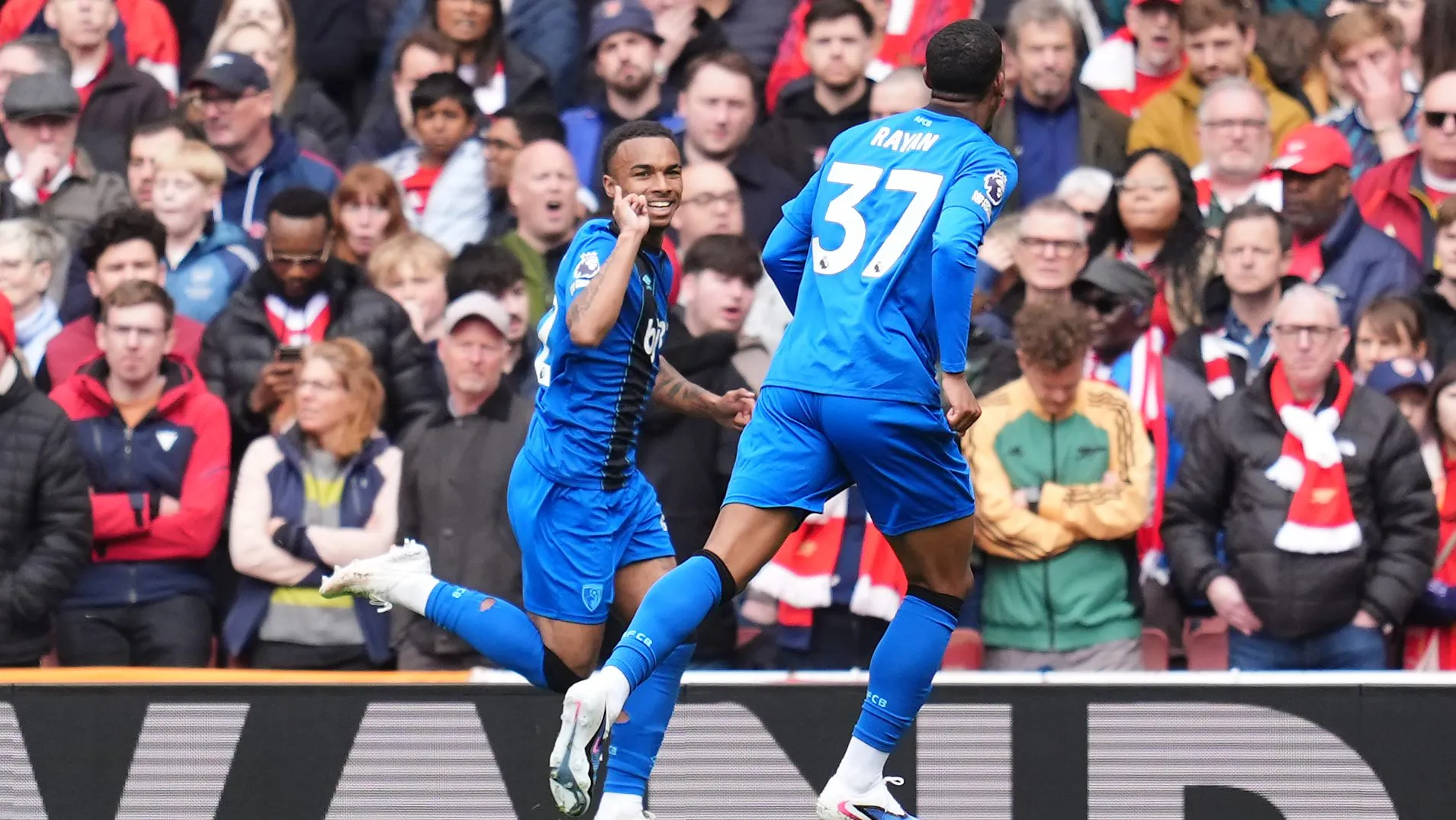
Then came the winner. During Bournemouth’s best spell of control, Evanilson received the pass from Brooks, drew defenders in, and with a pivô action created a corridor. Alex Scott ran into it, took the chance one-v-one with Raya, and fired the winner that landed like a verdict.
It wasn’t luck. It was structure meeting timing—Bournemouth being patient enough to wait for the exact moment Arsenal’s shape went thin.
What the loss says about Arteta ahead of the City swing
This is where the uncomfortable questions start for Arteta. When your leader’s identity depends on clean exits, stable midfield rotations, and quick combinations, what do you do when the opponent turns your saída de bola into a hostage situation?
Arsenal’s second-half changes added bodies, but the core issue—Bournemouth’s ability to keep the game compact and force mistakes—was still present. Raya’s pressure burden was visible. The midfield couldn’t consistently connect. And the team’s attacking rhythm kept getting disrupted by a press built on triggers, compact spacing, and fast interception paths.
Before the match-up with Manchester City, this matters. City don’t just press; they punish. If Bournemouth can expose the fault line, what happens when the opponent has even more quality to turn those transitions into goals?
O Veredito Jogo Hoje
This wasn’t a one-off stumble—it was a blueprint. Bournemouth exposed a structural weakness in Arsenal’s ability to play out under pressão alta, and it forced Arteta into tweaks that didn’t touch the root. If City arrive next, with their sharper timing and deeper attacking threat, Arsenal won’t just be “outplayed”; they’ll be suffocated—because Bournemouth showed the clearest route to making the Emirates feel smaller than it is. Signed, the tactical desk at Jogo Hoje.
Perguntas Frequentes
How did Bournemouth beat Arsenal away from home?
Bournemouth won by executing Iraola’s high-pressure system with a line defensiva compacta and a tight block medium-alto, strangling Arsenal’s build-up. They limited real midfield access, forced direct attempts, stayed patient after conceding, and then used a well-timed transition into the winner with Alex Scott.
Can Arsenal still lose the Premier League lead?
Yes. They remain top after the loss, but the margin can shrink quickly. If City win their game, they can close to six points, and the next direct clash at the Etihad turns the round into a genuine momentum swing.
What changes for Arteta before the duel with Manchester City?
Arteta has to address how Arsenal handle pressure on the saída de bola and how they protect the midfield against marking by encaixes. The squad may need a clearer plan for progressing under pressure and for reducing turnovers in the intermediate zone, otherwise City will turn Bournemouth’s blueprint into a bigger problem.