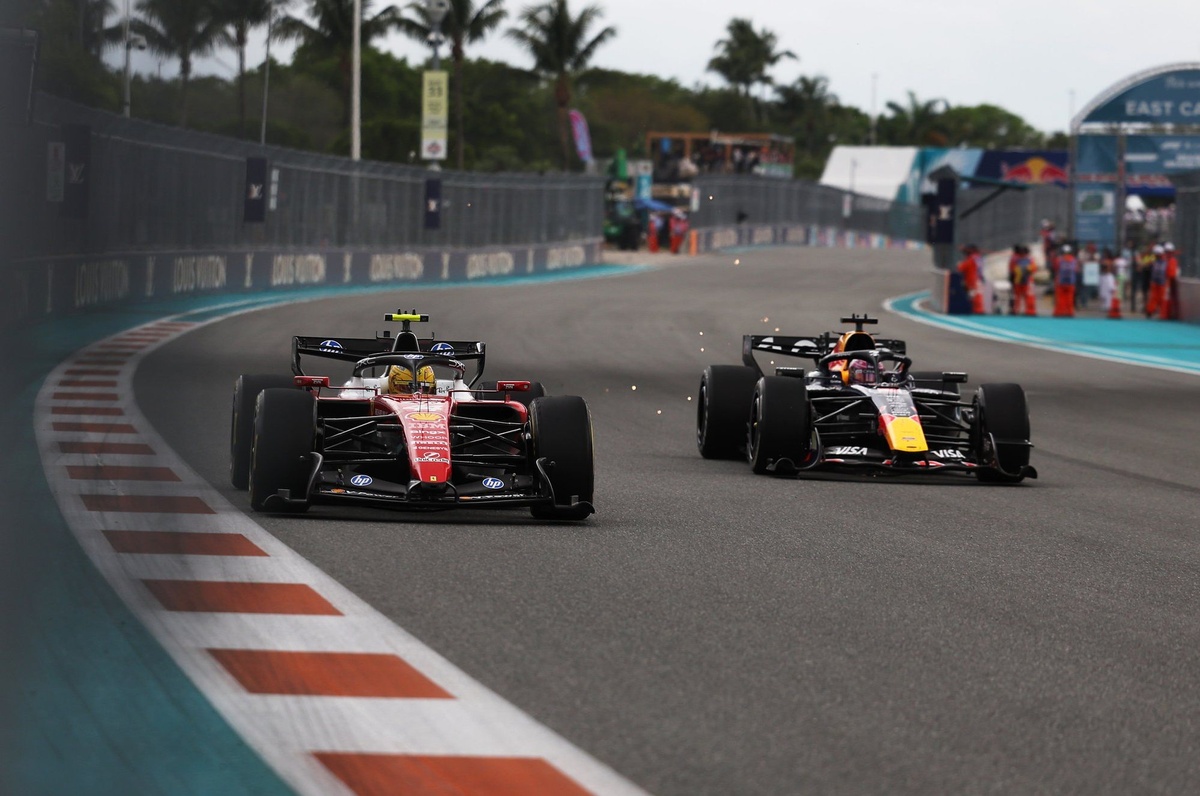
According to Jogo Hoje reporting, Red Bull’s Miami upgrade wasn’t just the kind of visual statement that grabs a camera operator. It was a technical bet on how the airflow should behave over the sidepod and into the diffusor, with the underfloor and the boundary layer doing the heavy lifting. And once rivals started dissecting it, the technical dispute stopped being theoretical and became practical.
Yes, the RB22 had plenty of attention around the rear wing concept. But the real story sat lower and deeper: a reworked sidepod package that brings back a “toboggan” surface concept, now interpreted through Miami’s specific geometry and regulated reference volumes.
What Red Bull changed in Miami
The RB22 chassis was seriously reworked for Miami, with the “toboggan” surface returning in a way we associate with earlier regulations. The key is the placement: the outer edge of the sidepod runs right along the allowed boundary of the reference volumes. That makes the recessed channel on the top of the sidepod wider, which immediately changes how the flow is guided toward the top of the underfloor.
It doesn’t work alone. Red Bull paired it with a revised underfloor and improved sidepod inlets that first appeared in Japan. Even the internal airflow around the radiators is different, likely because the previous sidepod layout was more compact and this new configuration sits further from the car’s centerline.
At the rear, the side surfaces taper into a pointed section that blends into the underfloor. Then the shape curves slightly inward toward the centerline, again staying within the permitted dimensions. In plain terms: the car is trying to keep the airflow attached longer while feeding the diffusor with cleaner, more stable conditions.
Why the concept grabs so much attention
This is the part where you feel the grid leaning in. Andrea Stella, Mercedes and Ferrari’s rivals on the stopwatch, basically told the world they’re watching the idea closely. His point was that the Red Bull lateral approach differs clearly from Mercedes and Ferrari, while McLaren has chosen its own direction. That’s not fan talk. That’s a development team admitting the concept has technical hooks worth testing.
And Mekies added the competitive context: after Japan, Red Bull sat about 1.2 seconds off pole; in China, that gap dropped to 1 second. Then Miami delivered a sharper signal. Mekies said on Friday they were around six tenths from pole, and on Saturday they were under two tenths. When a car closes the gap that fast, people don’t just admire the design—they chase the mechanism.
The “rule gap” that made this solution possible
Here’s the technical nudge that matters: the part of the rear “toboggan” surface seems to operate just outside what is strictly defined as a sidepod. It’s interpreted via the so-called reference boxes for the engine cover. That’s where the regulatory wording shows up, specifically Article C3.8.2, used as the basis for interpreting the bounding boxes.
The regulation sets curvature limits, including a minimum convex curvature radius of 75 mm and a minimum concave curvature radius of 50 mm. The optics of Red Bull’s shape suggest an external portion that appears smaller toward the tip, then transitions into a flatter-looking inner edge in the concave profile. That visual “step” is likely tied to how the geometry is made to fit within those curvature constraints.
So the question becomes: is it a loophole? Not exactly. It looks more like a smart legality margin exploitation—using the allowed curvature envelope to create a surface that behaves like a toboggan without being treated as a conventional sidepod element.
The aerodynamic gain behind the toboggan sidepod
A toboggan surface isn’t a decoration. Aerodynamically, it shortens the path the air takes over the sidepod toward the upper area of the underfloor. That means less energy loss from friction on the boundary layer. Less drag from the wrong places is a big deal, but the real win is what happens to attachment and pressure distribution.
Depending on the final shape, the surface can also introduce a controlled rotation in the flow. That helps keep the air more willing to stay attached as it heads toward the diffusor. When the flow is stable, the pressure difference between the upper and lower parts stays stronger and—crucially—more consistent. That consistency is what you feel as downforce that doesn’t fall off mid-corner and doesn’t punish the driver’s confidence.
Mekies framed it this way: the upgrade wasn’t only about raw aero gains. It also improved drivability. After Suzuka, Red Bull concluded it didn’t have a consistent car—one drivers could trust lap after lap. The team then worked intensely for five weeks, and the Friday-to-Saturday step in Miami’s pole gap was the scoreboard proof.
How rivals can react to the new trend
Rivals aren’t blind. They’ll measure what Red Bull changed, then test whether the concept can be replicated within the same legal interpretation. Stella essentially telegraphed the process: teams analyze, test, and compare solutions, and the Red Bull geometry becomes a reference point for what might be achievable.
But copying isn’t plug-and-play. The sidepod and underfloor don’t live in isolation. A change in the sidepod alters how the boundary layer develops, how the wake interacts with downstream surfaces, and how the car balances across different ride heights and cornering loads. If you chase the same downforce without matching the rest of the system, you might get the peak numbers but lose the stability.
Still, the direction is clear: if the “toboggan” approach yields measurable improvements in pressure consistency and diffuser feeding, expect the grid to start converging on similar curvature-driven surface behaviors—within the reference boxes and curvature radii constraints of Article C3.8.2.
What Mekies and Stella reveal about the technical fight
Stella’s comments show the competitive mind-set behind the scenes. When he says the lateral philosophy differs from Mercedes and Ferrari while McLaren took another route, it’s a reminder that this is not one single “correct” design. It’s a race to find the best airflow management strategy for each car’s constraints.
Mekies, meanwhile, ties the aero package back to performance reality. He linked the progress to both downforce and confidence: they reduced the lap-time variance that comes when the rear end and underfloor flow aren’t repeating reliably. That’s why the pole gap trend matters. 1.2 seconds off pole became 1 second after China, then tightened to six tenths on Friday and under two tenths on Saturday in Miami.
When a team can quantify improvement like that, it suggests the concept is doing more than look clever. It’s altering how the car holds its line aerodynamically.
O Veredito Jogo Hoje
Let’s call it what it is: Red Bull didn’t just bring a new sidepod shape to Miami, they brought a repeatable airflow story—one that attacks boundary layer losses, stabilizes pressure for downforce, and feeds the diffusor with a flow state drivers can actually trust. And if that “toboggan” legality interpretation around the reference boxes (with those 75 mm and 50 mm curvature limits) proves robust across tracks, the rest of the grid won’t admire the design from the stands—they’ll redesign their cars around the same logic. That’s not a trend. That’s a development fork in the road, and Red Bull just shoved the steering wheel.
Perguntas Frequentes
What did Red Bull change in the sidepod in Miami?
Red Bull reworked the RB22 sidepods to reintroduce a “toboggan” surface concept, widened the recessed channel by placing the outer edge on the boundary of allowed reference volumes, paired it with a revised underfloor, improved the sidepod inlets introduced in Japan, and altered airflow paths around the radiators.
Why could this aerodynamic concept give an advantage?
The toboggan reduces the airflow’s friction losses over the sidepod, helps keep the boundary layer more controlled toward the diffusor, and supports a larger, more consistent pressure difference—boosting downforce and improving corner-to-corner balance and driver confidence.
Can rivals copy this solution within the rules?
They can try. The concept appears to use a geometry interpretation linked to Article C3.8.2 and the curvature limits for the reference boxes, including minimum convex and concave radii of 75 mm and 50 mm. However, replicating it isn’t just about the shape—it requires matching the wider airflow and underfloor package to get the same stability and performance.