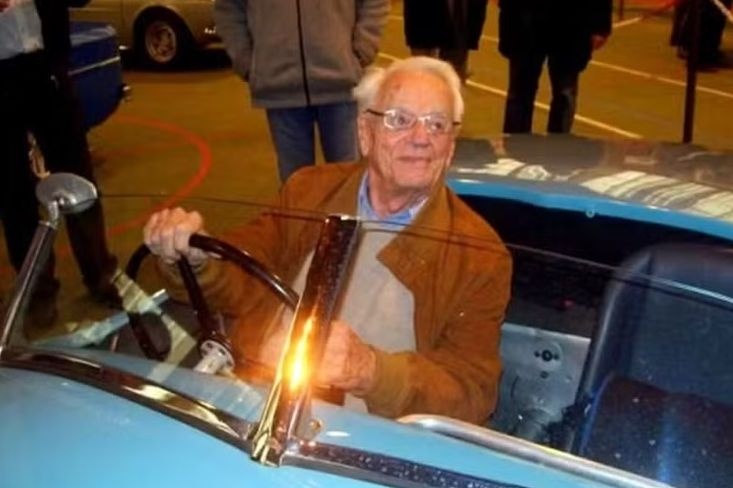
Jogo Hoje, according to our records, has been covering this corner of racing history the way it deserves: with memory, not noise. Today, we’re marking the passing of Hermano “Nano” da Silva Ramos at the age of 100, a pioneer of Brazilian motorsport and one of the earliest representatives of the country in the era heroica da Fórmula 1.
He died on 4 May, after a life that carried the scent of gasoline, the weight of wars, and the stubborn optimism of drivers who raced because there was no Plan B. In Biarritz, in the south of France, he had been hospitalized with pneumonia, and from there the story closed—quietly, like so many great chapters in motorsport history.
The death of a pioneer of Brazilian motorsport
When a driver like Nano da Silva Ramos goes, it isn’t just a headline—it’s an entire timeline that goes dim. Born on 7 December 1925, he arrived at the starting grid when Formula 1 was still finding its identity, when every weekend felt like a wager and the cars carried both engineering ambition and raw risk.
And yes, we’re talking about a man whose presence in the Formula 1 paddock still echoes when people discuss who paved the road for Brazil. He was the third Brazilian to race in the category—after Chico Landi and Gino Bianco—and he held a special position in the country’s racing memory for years, before the era of Emerson Fittipaldi truly changed the scale.
Who was Nano da Silva Ramos?
Nano da Silva Ramos was the kind of figure you don’t fully understand until you trace the details. He was born in Paris, the son of a Brazilian father and a French mother, and after the Second World War he returned to Brazil, shaping his path with the same blend of discipline and flair that defined so many post-war careers.
He began racing at 21, in 1947, and soon moved through the natural ladder of that time: sports cars in France, then the 24 Hours of Le Mans, a race that doesn’t care about your résumé—only your consistency and nerve. The Le Mans experience wasn’t a side quest; it was part of the education that made him competitive when the spotlight finally turned to the circuits of Formula 1.
His Formula 1 run and the historic Monaco result
Nano arrived in Formula 1 in 1955 with equipe Gordini, disputing seven GPs. He debuted at the GP of the Netherlands that year, finishing eighth—exactly the kind of result that doesn’t look flashy on paper, but matters when you’re building momentum in an era where reliability was half the battle.
The real statement came in 1956 at the GP de Mônaco de 1956. He started 14th, crossed the line fifth, and in a season where only the first six collected points, he scored two. Those pontos na F1 were the only ones of his career, which makes them even more valuable—because they weren’t accumulated over years; they were earned in a single, razor-edged moment.
It’s hard not to ask: if the points system and the opportunities were different, what would his arc have looked like? That’s the kind of counterfactual that keeps historians up at night.
Le Mans, return to the track, and retirement
While Formula 1 is where his name is often pinned, the bigger picture belongs to the long-distance world. He competed in the 24 Hours of Le Mans in 1955 and again in 1959. In 1955, the race carried an unforgettable tragedy at La Sarthe, with 84 people losing their lives—an event that still sits in the collective memory of motorsport.
After leaving Formula 1 in 1957, Nano didn’t disappear from the sport’s orbit. He returned in 1958, taking part in Touring and F2 events. The following year, he once again entered Le Mans, this time driving for Ferrari.
By the time he decided to hang up the helmet, he had lived the full rhythm of that generation—racing hard when you could, walking away when the body and the heart said enough. His final competitive appearance in 1959 came in a sports-car race in Rio de Janeiro.
Why Nano entered Brazil’s Formula 1 history
Here’s where the legacy gets real. Nano da Silva Ramos was the third Brazilian to race in Formula 1, and for a stretch of time he was also the country’s top scorer in the category. Until Emerson Fittipaldi arrived and overtook that record, Nano represented something Brazil hadn’t quite seen at scale in the early days: the ability to turn seat time into pontos na F1.
In the era heroica da Fórmula 1, where the machines were temperamental and the margins were razor-thin, he didn’t just participate—he left evidence. A debut eighth at the Netherlands, and then those two points from the GP of Monaco 1956. That’s not a trophy case; it’s a footprint.
And let’s not forget the human thread: he stepped away in 1957, shaken by the death of Spain’s Alfonso de Portago, a close friend, who perished at the Mille Miglia in Brescia that year. Motorsport was never only metal and speed. It was grief, too.
Viewing, burial, and reaction from the racing world
Nano da Silva Ramos passed away in Biarritz after pneumonia, and the plans for his funeral are for 8 May in France. For those of us who grew up reading race reports like sacred texts, this is the moment where you don’t try to “analyze” too much—you simply acknowledge what a life in automobilismo brasileiro represents.
Within the paddock’s memory, he remains the kind of pioneer who didn’t ask to be remembered, but inevitably is. Because the early Formula 1 story—messy, dangerous, brilliant—would be poorer without names like his.
O Veredito Jogo Hoje
We don’t treat this kind of death like a statistic. Nano da Silva Ramos belongs to the foundation layer of Brazilian motorsport, the era when showing up was already a statement and points were like rare gems. His Monaco 1956 haul, his Gordini route into F1, his Le Mans chapters, and the way he carried Brazilian pride across the Atlantic—this is the kind of legacy that deserves respect, not gimmicks. If modern fans want to understand where the ambition came from, they should look back here. This wasn’t just history; it was the start of a belief.
Perguntas Frequentes
Who was Nano da Silva Ramos?
Hermano “Nano” da Silva Ramos was a Brazilian-born-in-Paris racing driver who became one of the earliest Formula 1 representatives from Brazil, competing with teams including Gordini and also racing in the 24 Hours of Le Mans before and after his F1 years.
How many races did Nano compete in during Formula 1?
He disputed seven Formula 1 Grands Prix.
What was Nano’s best result in Formula 1?
His best finish was fifth place at the GP of Monaco in 1956, which earned him two points—his only points in Formula 1.