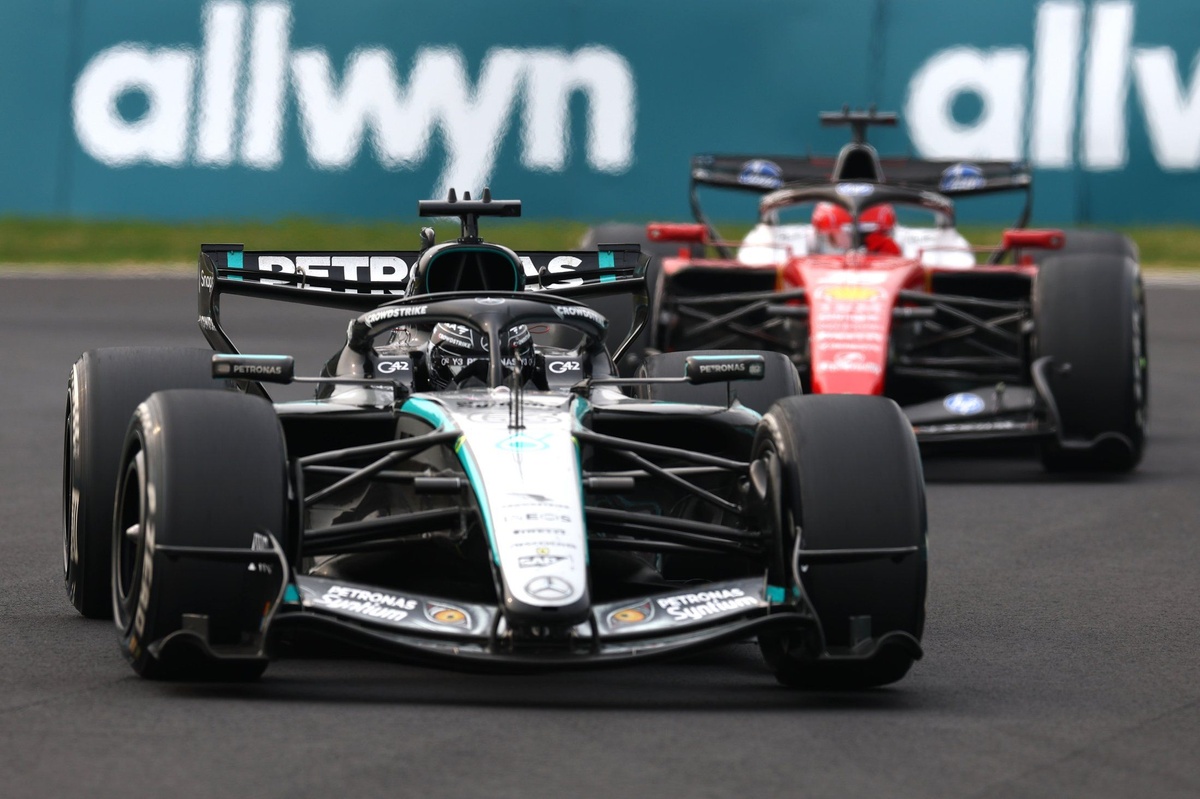
After three rounds of the 2026 season, Mercedes isn’t just collecting wins, it’s stacking evidence. According to our F1 coverage at Jogo Hoje, the opening chapters of this campaign already read like a statistical case file: Ferrari can get close on the stopwatch, but the underlying performance gap is behaving like something closer to a trend than a blip.
Yes, the races have sometimes felt tense. But when you switch from vibes to metrics, the story changes. The Mercedes lead is being underestimated because the most visible moments are not always the most diagnostic ones. That’s what makes this nerdy little dataset so spicy.
What the track shows and what the numbers hide
Mercedes won the first three GPs of 2026, including the sprint in China. That part is obvious. What’s less obvious is how the margin is being “edited” by randomness and racecraft friction: poor starts, moments in ar limpo versus dirty phases, and the way traffic can turn the same car into two different machines.
Let’s talk about the distance that really matters. The headline gap in standings is not the whole picture, because qualification and race pace are different beasts. Still, the numbers line up uncomfortably for the chasing pack: Ferrari sits about 0.56 seconds back on average in ritmo de classificação and roughly 0.53 seconds per lap in ritmo de corrida.
In plain terms: if Ferrari is consistently that far off on pace, how are they supposed to close it just by finding one extra overtake opportunity? The answer is that they’re not closing it with tools they don’t have. They’re closing it with the occasional chaos event, and then hoping the season keeps rolling dice their way.
And for Mercedes, the most telling variable is consistency in clean conditions. When the air is ar limpo, the team looks almost ruthless: pressure doesn’t stick because Ferrari, McLaren and Red Bull struggle to generate sustained threats. They may gain something in the opening exchanges, but they can’t keep the pressure on long enough to translate it into a real points swing over a full stint.
The real distance to Ferrari, McLaren, and Red Bull
Ferrari is the closest pursuer after the first three weekends, but “closest” doesn’t mean “close.” The gap is still sitting in the same neighborhood as last year’s reality, which is a polite way of saying: the chasing pack hasn’t even started the kind of catch-up sprint that a normal title fight requires.
Here’s the statistical gut-check. In 2025, when McLaren had the most convincing package, it led Red Bull by just 0.19 seconds on average. That’s a small margin even for a dominant era. In 2023, Red Bull’s run—19 wins out of 22—still produced only 0.19 seconds of average advantage over Ferrari in qualifying. Even when you find a “comparable” year, the scale doesn’t match.
Now jump to 2020, the season where Mercedes’ strength looked similarly inevitable. Back then, Mercedes beat Red Bull by about 0.55 seconds on average in qualifying. That number is eerily close to what we’re seeing in 2026’s early data. And if you want the straight-up horror-movie comparison for the rivals, 2016 is the reference point: Mercedes held a 0.74 seconds average advantage over Red Bull in qualifying. That’s a level of separation you don’t “negotiate” away with clever strategy calls.
So what’s happening in 2026? The simplest interpretation is that Mercedes’ vantagem média is showing up in two places at once: vantagem média in qualifying and the diferença por volta in ritmo de corrida. When both line up, you don’t just have a fast car. You have a fast car that survives the messy parts of weekends.
- Mercedes: three straight GP wins, including the China sprint
- Ferrari: roughly 0.56 seconds down in qualifying rhythm
- Ferrari: roughly 0.53 seconds per lap down in race rhythm
Why bad starts distort the read on dominance
Let’s be honest: a lot of fans are judging this season with highlight footage, and highlights love drama. A mediocre start by the pole sitter can manufacture a “fight” even when the gap is still massive underneath.
Bad starts are the perfect illusion machine. They can compress the field, force drivers into traffic, and turn clean pace into inconsistent lap times. Add dirty air and suddenly the same dominant car looks mortal for a few laps. But that’s not the whole performance curve; it’s the performance curve after interference.
So when Ferrari looks dangerous right after the lights, it might be less about “closing the gap” and more about Mercedes being briefly denied the conditions where it looks best. The question we should be asking is not whether Ferrari can look close for a lap. The real question is whether they can do it long enough to create a points swing without relying on mistakes as a crutch.
Because the hard truth is this: if the only reason the rivals get close is largadas ruins, then the lead is still there. It’s just being temporarily masked by race entropy.
Comparison with the biggest hegemonies of modern F1
Every era has its villain, but the numbers decide whether it’s a villain or a myth. In 2014, Mercedes opened a 0.83 seconds average advantage over Red Bull in qualifying. That’s one of those statistical cliffs that makes analysts sit up straight. And if you want to stretch the timeline, the early 2000s had historic outliers too.
Ferrari’s peak in 2001 is often cited for a 0.37 seconds advantage over McLaren, while Red Bull’s best number in 2010 is quoted as a 0.4 seconds advantage over Ferrari in qualifying. Those figures are impressive in their own right, but 2026’s early pattern sits in a more alarming category because it echoes the Mercedes qualifying separation seen in the most dominant hybrid-era spells.
Then there’s the “can anyone actually catch them?” lesson. In 2018, the closest comeback example in this family of narratives is Ferrari reducing the difference to just 0.08 seconds. That’s the kind of convergence that doesn’t happen by luck. It takes time, development direction, and enough regulation stability to prevent the chasing pack from being forced into a moving target.
And that brings us to the big twist of 2026: it isn’t just a normal season. It’s a year under the regulamento de 2026, with an emphasis on behavior and technical constraints that could force teams to find solutions faster. The key phrase here is convergência técnica.
Still, the “convergence” doesn’t automatically erase a performance mountain. If Mercedes is already stacking diferença por volta and qualifying separation at a historic cadence, rivals need more than incremental steps; they need a development leap that changes the shape of the curve.
What the 2026 rulebook can change from here
Here’s the nuance that separates smart optimism from wishful thinking. The 2026 rules, especially around power unit elements like the motor side, are designed to accelerate convergência técnica. That could shorten the usual gap-closure timeline, meaning the rivals might get their “first real step” earlier than they would have in a traditional cycle.
But the same rulebook can also punish teams that misread the direction. If Mercedes has already found a setup and design philosophy that plays nicely with the new constraints, then even faster convergence might still land the chasing pack behind.
And don’t forget the human factor: when pace is strong, errors are rarer, and the team managing the weekend tends to make fewer costly mistakes. That’s how you convert raw performance into points, sprint after sprint, lap after lap.
So will Ferrari, McLaren, and Red Bull reduce the gap? Of course they will try. But the data suggests the Mercedes lead isn’t only “race-day dominance.” It’s living inside the ritmo de classificação, inside the ritmo de corrida, and inside the team’s ability to stay composed when the ar limpo advantage disappears for a few corners.
O Veredito Jogo Hoje
Mercedes isn’t winning by a little more this time; it’s winning in a way that reads like a statistical outlier. When qualifying separation is around 0.56 seconds and the diferença por volta sits near 0.53 seconds, you don’t have a “tight championship” hiding behind occasional close battles—you have a lead that keeps its shape even when starts go wrong and the track gets messy. Ferrari, McLaren, and Red Bull can absolutely chip away, but the burden of proof is on them to show actual pace convergence, not just highlight-reel competitiveness. Assinado, o nosso Nerd Estatístico que prefere a planilha ao barulho do rádio.
Perguntas Frequentes
Qual é a vantagem real da Mercedes na F1 2026?
Os dados iniciais apontam uma separação média de cerca de 0,56 segundo na ritmo de classificação e aproximadamente 0,53 segundo por volta no ritmo de corrida, o que sugere uma vantagem real maior do que a impressão deixada por corridas às vezes apertadas.
A Ferrari está realmente perto da Mercedes?
Em termos de “sensação” de corrida, às vezes parece que sim por causa de disputas e momentos de pressão. Mas nas médias de desempenho a Ferrari está atrás, com a diferença aparecendo de forma consistente tanto na ritmo de classificação quanto no ritmo de corrida.
A nova regulamentação de 2026 pode diminuir essa diferença?
O regulamento de 2026 pode acelerar a convergência técnica, especialmente em áreas ligadas ao motor, o que tende a encurtar prazos de aproximação. Ainda assim, para virar o jogo, os rivais precisam converter essa convergência em passos reais de vantagem média e reduzir a diferença por volta, não apenas ganhar terreno em cenários específicos como ar limpo.