There are seasons you remember for the trophies, and seasons you remember for the what-ifs. According to those who lived it from the inside, Mercedes still carries a quiet, stubborn ache: the chance to see Michael Schumacher lift a win in their colours never arrived in the three years that mattered most.
And if you want the wider F1 picture, the way we’ve been tracking the sport at Jogo Hoje helps frame how rare that kind of “nearly” really is. Because in 2014, Mercedes became a machine. But before the hegemonia kicked in, there was rebuilding, risk, and a return that felt like history trying to rewrite itself.
The Mercedes return to F1 and the Schumacher bet
Mercedes’ story of late success didn’t fall from the sky. It started with a purchase that looked like a gamble at the time: the team was born from Mercedes acquiring Brawn GP at the end of 2009, turning the page on a messy era and officially marking the brand’s return as a factory outfit in Formula 1.
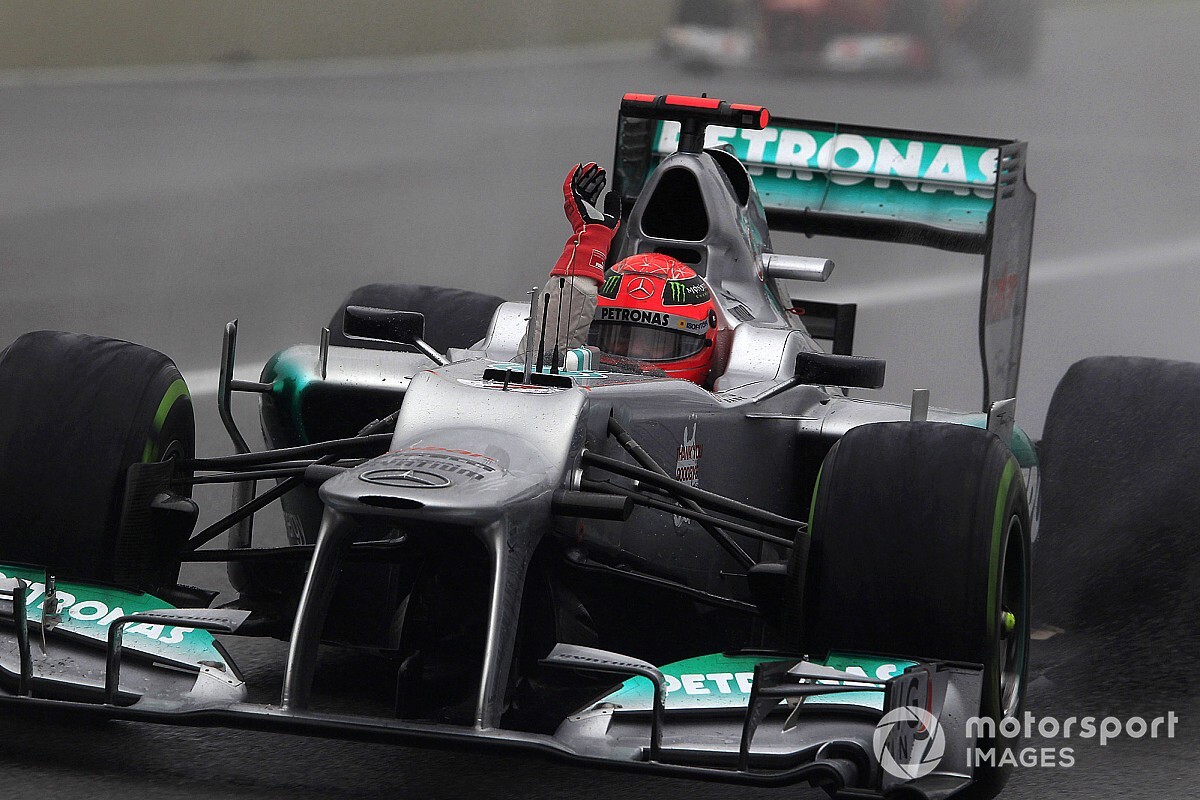
From there, the project gained a face and a spine. Schumacher came back to lead the charge, alongside Nico Rosberg. For three seasons, the duo carried the weight of expectation, mixing experience with a strategy that was more about reconstruction than instant dominance. And yet, the statistic that still stings never changed: Schumacher raced for Mercedes, but he didn’t win a Grand Prix during that stretch.
He retired for good at the end of 2012, leaving behind a familiar mix of brilliance and frustration. Because when you see what came after, when you watch Mercedes lock onto pace and rhythm with ruthless efficiency, it’s hard not to ask: what if the first signature win had landed when it had the best chance to?
The real Monaco 2012 opportunity that slipped away
Monaco 2012 was the kind of weekend that makes fans hold their breath. Schumacher had pole position, and on a circuit where small margins become destiny, that’s not just an achievement—it’s a doorway.
But the doorway didn’t open cleanly. He couldn’t take advantage because he had to serve a punição no grid, a five-place penalty, handed down after the previous Spanish Grand Prix. Five spots. On paper, it’s a number. In Monaco, it’s the difference between controlling the race and spending your afternoon firefighting.
James Vowles, who was then responsible for race strategy at Brackley, described the emotion with the kind of blunt honesty only someone close to the cockpit can have. He said he was “in the clouds,” believing it was one of Schumacher’s best laps, and that he was truly heartbroken because everyone wanted to see him win a race—especially a race that felt like it belonged to him.
And the picture Ron Meadows paints is even more telling. As he put it, seeing Schumacher help the team progress made him one of the biggest regrets: not witnessing Schumacher win with Mercedes. He wasn’t just a driver; he was a level the team hadn’t seen before. So when he didn’t get the result, it wasn’t just bad luck—it felt like the sport denying a reward that, frankly, had been earned.
There was only one moment of joy on the pódio for Schumacher with Mercedes: Valencia in 2012. One. In a three-season span that later became a prelude to two straight years of wins starting in 2014, that lone podium reads like a footnote to a larger narrative.
What James Vowles and Ron Meadows said about the regret
Here’s the thing about regret in elite sport: it’s rarely loud. It’s usually quiet, tucked behind meetings and telemetry reviews. Vowles’ words capture that tenderness—the sense that the team invested so much of its life into Schumacher, and that the reward never fully landed.
Meadows, meanwhile, frames it with the cold logic of performance. Schumacher wasn’t just winning everywhere else earlier in his career; he was helping the team evolve its estratégia de corrida, its decision-making, its learning curve. Two years later, Mercedes wasn’t stopping anymore. Meadows credits Schumacher with that foundation—so how could the absence of a win not linger?
Even Schumacher’s approach, as Vowles recalls, carries a kind of dignified acceptance. He knew where his car-driving strengths were, where they weren’t, and he worked relentlessly to close gaps against Rosberg. Yet there were limitations tied to age—areas no engineering wizardry could fully erase. He understood the clock was running, but he still tried to squeeze every ounce out of the weekend.
Why Schumacher mattered even without Mercedes wins
People love to reduce eras to trophies, but legacies are built in the in-between. Schumacher’s influence for Mercedes wasn’t only measured by checkered flags; it was measured by the way the team sharpened itself.
Watching him in that period is like studying a masterclass in adaptation. He pushed the car forward while the team itself was still learning how to extract consistency. That period of reconstrução da equipe wasn’t glamorous, but it was essential. It trained Mercedes to think faster, plan cleaner, and execute with more nerve.
And when the 2014 breakthrough arrived, it didn’t appear out of nowhere. The hegemonia that fans later associated with Mercedes—dominance so complete it felt almost inevitable—had roots in those earlier months of grinding, correcting, and building trust between driver feedback and technical direction.
Schumacher’s presence also gave the project a psychological edge. Not because he could force wins out of thin air, but because he demanded a standard. On days when the results didn’t show up on the scoreboard, the work still mattered. That’s the part outsiders often miss.
How the phase prepared the Mercedes dominance from 2014
By the time 2014 rolled around, Mercedes had already done the hard homework. The team had been through the transformation from Brawn GP into a factory operation, it had rebuilt systems, it had refined its estratégia de corrida, and it had learned how to keep a performance trajectory steady under pressure.
Schumacher didn’t deliver a win in those years, sure. But he helped compress the learning curve. He accelerated the team’s understanding of what the car needed to do, and what the driver needed to feel. That’s not a sentimental claim—it’s practical. In racing, the fastest route to dominance is often the slow grind of reconstruction.
So when you look back at Monaco 2012—the pole position, the punição no grid, the heartbreak—you can feel the tension between potential and outcome. And when you then look forward to 2014, you can’t help but wonder whether that first missing win would have changed the emotional texture of the whole era.
O Veredito Jogo Hoje
For us at Jogo Hoje, the tragedy isn’t that Schumacher failed to win with Mercedes—it’s that the sport, with all its machinery and rules, managed to steal the cleanest narrative moment. Monaco 2012 had the ingredients for a statement, and the punição no grid turned it into an endurance lesson instead. Mercedes went on to build the hegemonia they became famous for, yes, but that lost win remains the one scar the rebuilding years couldn’t fully cover. Schumacher didn’t just belong to the past—he helped carve the future, even when the trophies refused to show up.
Perguntas Frequentes
Why does Mercedes consider the Schumacher years a regret?
Because Schumacher returned to lead the project and never secured a Grand Prix win with the team during his Mercedes stint, even when opportunities were there—most painfully highlighted by Monaco 2012.
In which race was Schumacher closest to winning for Mercedes?
Monaco 2012 stands out: he took pole position but couldn’t convert it due to a five-place grid penalty carried from the prior Spanish Grand Prix.
How many podiums did Schumacher achieve with Mercedes?
He finished on the pódio once with Mercedes: Valencia in 2012.