According to Jogo Hoje’s own historical reading of the sport, the Mercedes story didn’t simply “restart” when the factory team name came back in late 2009. It restarted with a bet on memory, on craft, and on a driver who had already written legends elsewhere. And yet, as time softened the edges of that rebuilding chapter, one particular absence kept coming back to haunt the people inside Brackley.
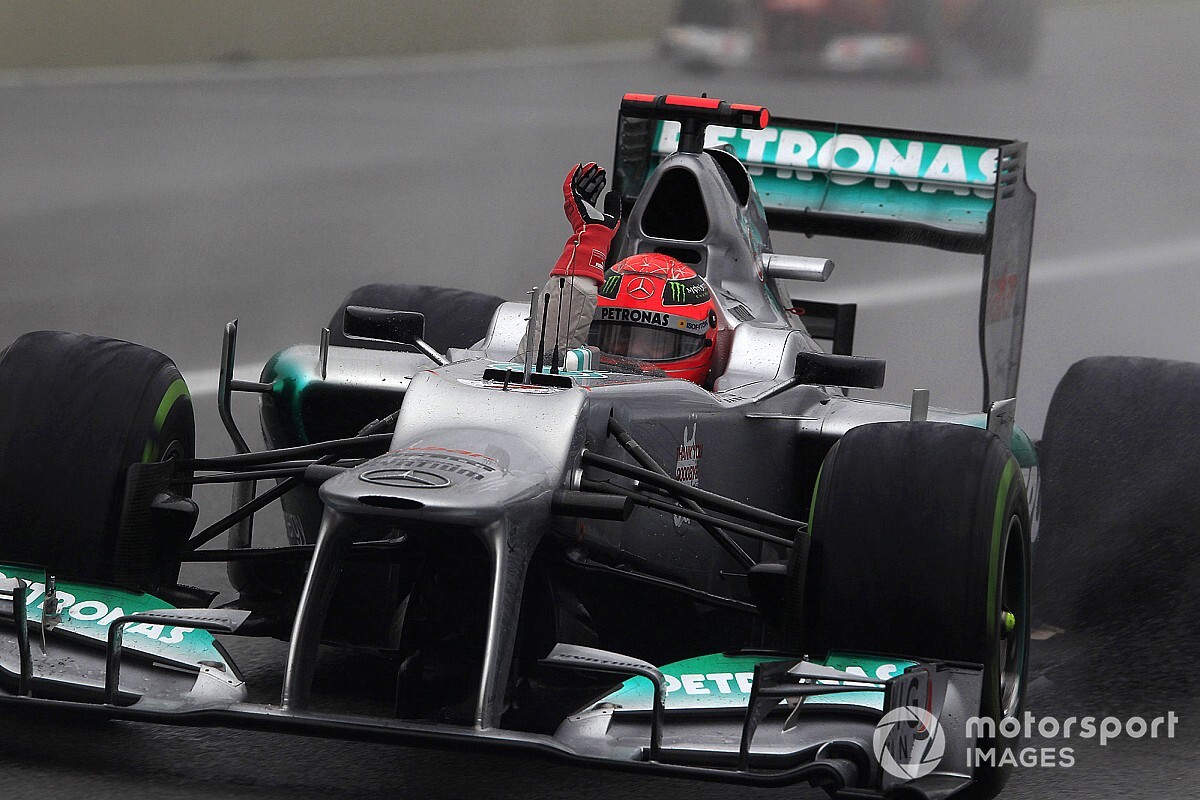
Mercedes bought Brawn GP at the end of 2009, stitched together a new identity, and then leaned hard on Michael Schumacher to lead the project. For three seasons, Schumacher ran alongside Nico Rosberg, carrying the weight of expectation while the team learned how to translate ideas into lap time.
The return of Mercedes and the Schumacher bet
It’s tempting to look at the Mercedes dominance that arrived later and treat the road to 2014 as a straight line. But anyone who’s lived through a rebuild knows it’s never that clean. It’s false starts, late-night debriefs, and the kind of development aerodinâmico work that doesn’t trend on social media but decides weekends anyway.
Schumacher’s arc with Mercedes ended at the close of 2012, when he stepped away for good. From the outside, that sounds tidy: three seasons, then retirement. From the inside, it was more complicated. He didn’t just arrive to provide experience; he arrived to sharpen the team’s thinking. Still, there was a cruel twist in the ledger—no grand prix wins to show for the effort.
Why the 2012 Monaco GP became the great missed chance
And if you want the moment people keep replaying when they talk about what “could have been,” it often circles back to Monaco 2012. Schumacher was on pole position there—one of those days when the front row feels like a promise you can almost touch. The problem? Promises don’t count points unless you’re allowed to cash them in.
In Monaco, Schumacher couldn’t convert that pole into the win because he had to serve a penalidade de cinco posições on the grid. That punishment came from the previous race in Spain, and suddenly the race felt like it was being fought on two fronts: the track, and the rules book.
James Vowles, who was responsible for strategy at the time, later put it into words with the kind of honesty only veterans can afford. He said he believed Schumacher had delivered one of the best laps of his life, yet he was “heartbroken” that the moment arrived under penalty.
So here’s the question we can’t stop asking, even with the years stacked behind us: how many times does F1 hand you a perfect setup and then slam the door with administration? Monaco is unforgiving like that. It doesn’t forgive. It just records.
What Vowles and Ron Meadows say about Schumacher’s legacy
Vowles didn’t hide the emotional side of it, but he didn’t let the emotion erase the professionalism either. He framed it as compassion for a driver who had poured himself into the team, day after day, like the reward was supposed to arrive on the same calendar as the work.
Ron Meadows, Mercedes’ sporting director, carried the same ache, only with a different angle. He called it one of his biggest regrets that he never got to see Schumacher win a race with Mercedes. Meadows didn’t pretend it was a mystery why everyone wanted it; Schumacher was a driver of a level they hadn’t experienced before. The people around him, in that rebuilding stretch, weren’t chasing a fairy tale. They were chasing the obvious.
And then, two years later, Mercedes didn’t just win. It started stacking victories like it had been born for it. Meadows’ point is clear in hindsight: part of the credit for that leap belongs to Schumacher’s presence and the way he helped the team evolve, even if the trophy cabinet didn’t fill during his time.
Schumacher also approached the craft like a student and a surgeon at the same time. He knew where his weaknesses were, accepted them, and kept attacking them. But there were limits he couldn’t bargain with—areas tied to age, the kind no coaching can fully reverse. He understood when it was time to stop trying to force the impossible.
How Schumacher helped prepare the Mercedes champion
Here’s where the nostalgia turns into something more useful than sentiment. Because while Schumacher didn’t win for Mercedes, he still left a legado técnico that fed the team’s development. You can feel it when you connect the dots from the rebuild phase to the machine that arrived in 2014.
Mercedes didn’t become a dominant force by accident. It became dominant by learning how to build, validate, and refine. Schumacher brought the rare combination of ruthless feedback and uncompromising standards. Even when the results were missing, the process wasn’t. That’s the part that matters to a historian: the moments that move the chess pieces aren’t always the ones that light up the fireworks.
And yes, the timing makes it sting. The team’s trajectory was already bending upward when Schumacher was still in the car, so the absence of a win feels less like bad luck and more like a storyline denied its final panel.
The lone podium and the weight of a winless spell
For all the effort, Schumacher collected just one pódio with Mercedes—at Valência in 2012. One podium. That’s the kind of number that looks small on paper, but it carries a massive symbolic load when you consider what Schumacher represented.
He had been a champion everywhere he went. With Mercedes, he became the builder and the mentor, but the win kept slipping out of reach. So when people like Vowles and Meadows talk about regret, it isn’t just about trophies. It’s about justice—what they believed Schumacher deserved for the investment he made in their future.
And we’ll say it plainly: F1 is a sport where timing is everything, and sometimes the sport times your heartbreak better than your glory.
What this phase explains about the dominance that came after
From 2014 onward, Mercedes turned into a powerhouse, a benchmark team that forced the grid to react instead of innovate. That dominance wasn’t only the product of parts and budgets; it was the product of a learning curve that started years earlier, right in that messy reconstruction period following the Brawn GP acquisition.
Schumacher’s role in that curve is the thread the team now acknowledges more openly. Not because it rewrites the past, but because it clarifies the foundation. The late regret, the melancolic tone in the quotes, the way they talk about a missed chance in Monaco—those aren’t just emotional flourishes. They’re a recognition that the path to 2014 had fingerprints from 2010 to 2012.
So if you’re looking for the “why,” it’s not about rewriting history with what-ifs. It’s about understanding that the final destination can be built on work that never received a win sticker—until much later, when the results finally caught up with the process.
O Veredito Jogo Hoje
Mercedes’ biggest regret isn’t merely that Schumacher didn’t stand on the top step in their colors. It’s that the sport denied him the one page of the script where leadership gets rewarded instantly. When you connect the dots—from the Brawn GP rebuild to the 2014 dominance—the truth is almost painful: Schumacher helped shape the winning machine, but the era didn’t give him the victory that would have made the tale feel complete. That’s the real sting, and we’re not buying the comfort of “it happens” anymore.
Perguntas Frequentes
Why does Mercedes consider the Schumacher years a regret?
Because despite Schumacher’s role in the team’s technical and strategic progress, he didn’t secure a race win with Mercedes, and Mercedes staff later said they never got to see him deliver the victory they felt he deserved.
Which race was Schumacher closest to winning with Mercedes?
The 2012 Monaco GP, where he took pole position but had to serve a penalidade de cinco posições on the grid due to an earlier incident in Spain.
How many podiums did Schumacher have with Mercedes?
He finished on the podium once with Mercedes, at Valencia in 2012.