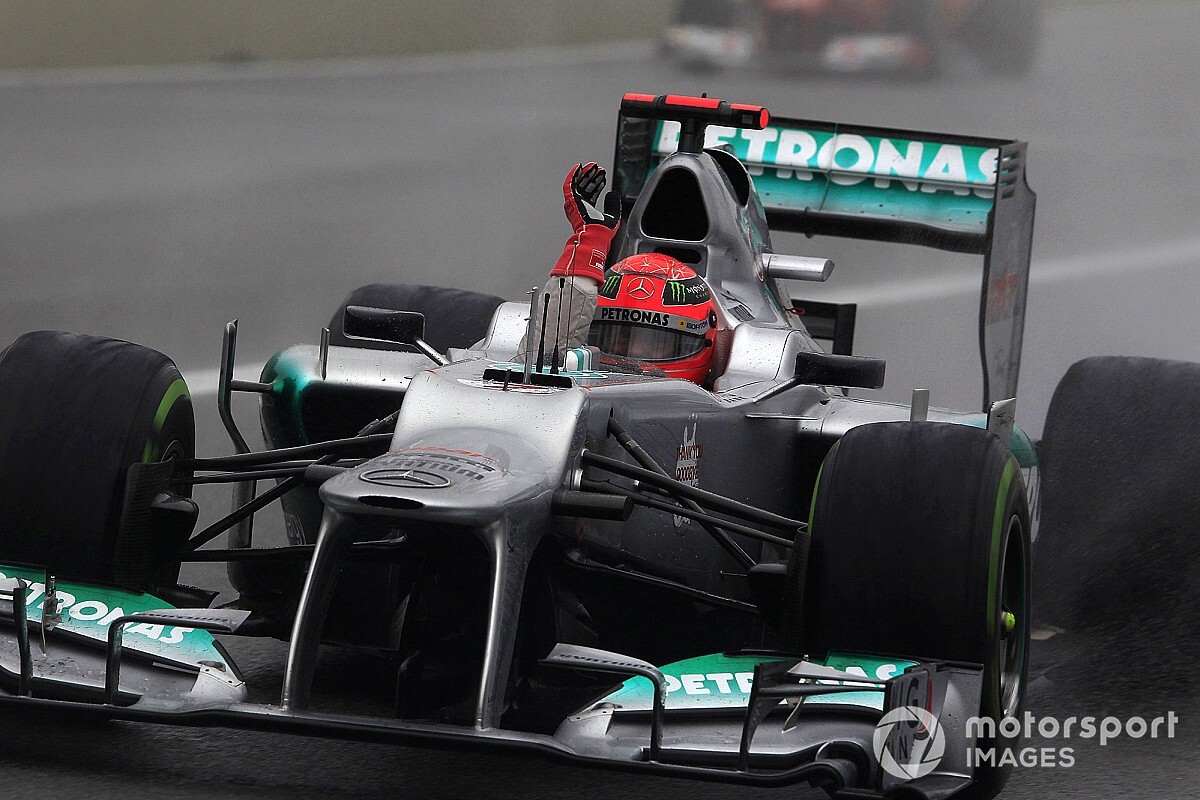
Long before 2014 turned Mercedes into a win machine, the team had to build itself from the ground up, born from Brawn GP after its end-of-2009 purchase. It was Mercedes’ official return as a factory outfit in Formula 1, and the appointment that made everyone sit up straight was Michael Schumacher. For fans of history, that pairing still feels like a door that almost closed and then… didn’t.
And yes, we’ve covered the twists of the sport for years on Jogo Hoje, but there’s a difference between watching eras happen and living with their what-ifs. Schumacher gave Mercedes three seasons, alongside Nico Rosberg, before his definitive retirement at the end of 2012. Yet for all the work, all the development of the car and the quiet belief in a lasting technical legacy, he never won a Grand Prix for the team. That absence? It still hangs in the garage like stale smoke.
Mercedes before the dominance: from Brawn GP to factory status
That early-2010s stretch was a rebuild dressed up as ambition. Mercedes wasn’t riding the kind of certainty that would arrive later; it was still chasing answers, still learning how to convert pace into results week after week. The raw ingredients were there, but the recipe wasn’t fully baked. When you buy a team like Brawn GP at the end of 2009, you inherit momentum and machinery, sure, but you also inherit deadlines, expectations, and the pressure to prove it all on track.
Schumacher’s arrival didn’t magically solve the physics overnight. What it did was raise the ceiling on standards. He wasn’t just a name on a contract; he was a measuring stick, the kind of driver who forces everyone around him to sharpen their instincts. And when a squad is still in construction mode, that kind of pressure can either forge a future… or expose a painful gap between potential and execution.
Schumacher at Mercedes: expectation, reconstruction, and the hunt for a win
Schumacher ran three seasons with Mercedes, paired with Rosberg, and for the team the goal was clear: turn learning into trophies. But the scoreboard didn’t cooperate. By the time the lights were out on his final season, he’d contributed to progress, pushed feedback into the steering wheel of the team, and helped the car evolve. Still, victories never came.
That’s why the words from James Vowles land with such weight, even years later. He described Schumacher’s Monza-era magic as something you could feel from inside the process, a feeling that never quite turned into the final box checked on race day. When a driver at that level doesn’t get the win, it’s not just a result missing; it’s a promise that never reached its destination.
Monaco 2012: the pole, the punishment, and the chance that slipped away
If you’re searching for the moment Mercedes felt it could finally exhale, it points straight to Monaco 2012. Schumacher took pole position, which is already a statement in a place where overtaking is basically a myth. Everything in that weekend screamed opportunity. But racing is cruel like that.
Because on the grid he had to pay for a five-place penalty from the previous GP in Spain. One small administrative wave, and suddenly the romantic script turned into a trap. Vowles later put it bluntly, recalling how Schumacher was “in the clouds” and how it might have been one of the best laps of his life. Yet the penalty stole the clean run at the moment when the whole team wanted to see the chequered flag find him.
And that’s the part that sticks. Not the technical gap, not the usual randomness. The timing. The punishment. The fact that the starting grid refused to cooperate with the story Mercedes had been trying to write.
By contrast, Schumacher’s only Mercedes pódio em Valência in 2012 came without the same fairy-tale gravity. It was proof of class, yes, but it wasn’t the full payoff the project deserved.
What Vowles and Ron Meadows say about Schumacher’s technical legacy
James Vowles and Ron Meadows don’t remember Schumacher as a museum piece. They remember him as a technician with a pulse, a driver who understood where the car hurt and where his own habits couldn’t be wishful thinking. Meadows, the kind of strategist who can turn a weekend into a spreadsheet of consequences, called not seeing Schumacher win one of his biggest regrets.
He framed it with a cold honesty that only people inside the process can manage: Schumacher was a level they hadn’t seen before, and everyone wanted the win. But in that stretch, “wanted” didn’t translate into “delivered.” And that matters, because it was supposed to be a reward for the investment of time, energy, and belief.
Vowles also highlighted how Schumacher approached the work. Even when he’d already done his greatest things with Benetton and Ferrari, he still treated Mercedes like a problem to solve. He knew his weaknesses, accepted them, and kept trying to plug holes through relentless iteration. In a way, that mindset is the real legado técnico people should talk about: not just the trophies, but the discipline of continuous development of the car.
Still, there’s a line he drew that’s impossible to ignore. There were areas linked to age, and those couldn’t be tuned out. The clock doesn’t care about engineering. It doesn’t care about feedback loops. Eventually, even the best driver in the world has to acknowledge when the moment has passed.
Why the lack of wins doesn’t erase the heptacampeão from the project
Here’s our take, and I’ll stand by it: judging that Mercedes rebuild only by whether Schumacher collected a checkered flag is too narrow, too convenient. Yes, the win was the headline Mercedes deserved to print. But the process he helped build is the reason the team could later flip the switch in 2014.
Schumacher’s presence accelerated standards. He pushed the team to refine how it interpreted data, how it shaped race strategy, how it understood tyre behaviour, and how it translated feedback into tangible upgrades. That kind of influence doesn’t vanish because the trophy cabinet stayed quiet.
And when you’re assembling a legacy, you don’t only inherit results. You inherit methods. You inherit a culture of accountability. You inherit a driver who could look at a car, identify the cracks, and demand better. That’s why Mercedes’ frustration still resonates: it wasn’t only about one win not happening. It was about an opportunity that looked so close, then got swallowed by a penalidade de cinco posições when the pole position moment deserved to become history.
O Veredito Jogo Hoje
Mercedes didn’t fail Schumacher in Monaco 2012; racing did what racing always does—punished timing and rewarded execution. But the sting is still real because that weekend felt like the exact intersection of preparation and destiny: the pole, the pace, the belief. So when people say the win “didn’t come,” I hear something sharper: a team built for the future, watching the past almost deliver its payoff. That’s not just nostalgia. That’s a chapter of the sport with an unfinished sentence.
Perguntas Frequentes
Why does Mercedes consider the Schumacher years a regret?
Because despite strong moments—especially Monaco 2012—the team never got the one thing it wanted most: a Grand Prix win with Schumacher, even though he was central to the team’s learning curve and technical progress.
Which race was Schumacher closest to winning with Mercedes?
Monaco 2012 stands out: he secured pole position, but a five-place penalty from the previous Spain GP meant the starting grid denied the clean path to victory.
How many podiums did Schumacher achieve with Mercedes?
He finished on the podium only once with Mercedes, at Valencia in 2012.