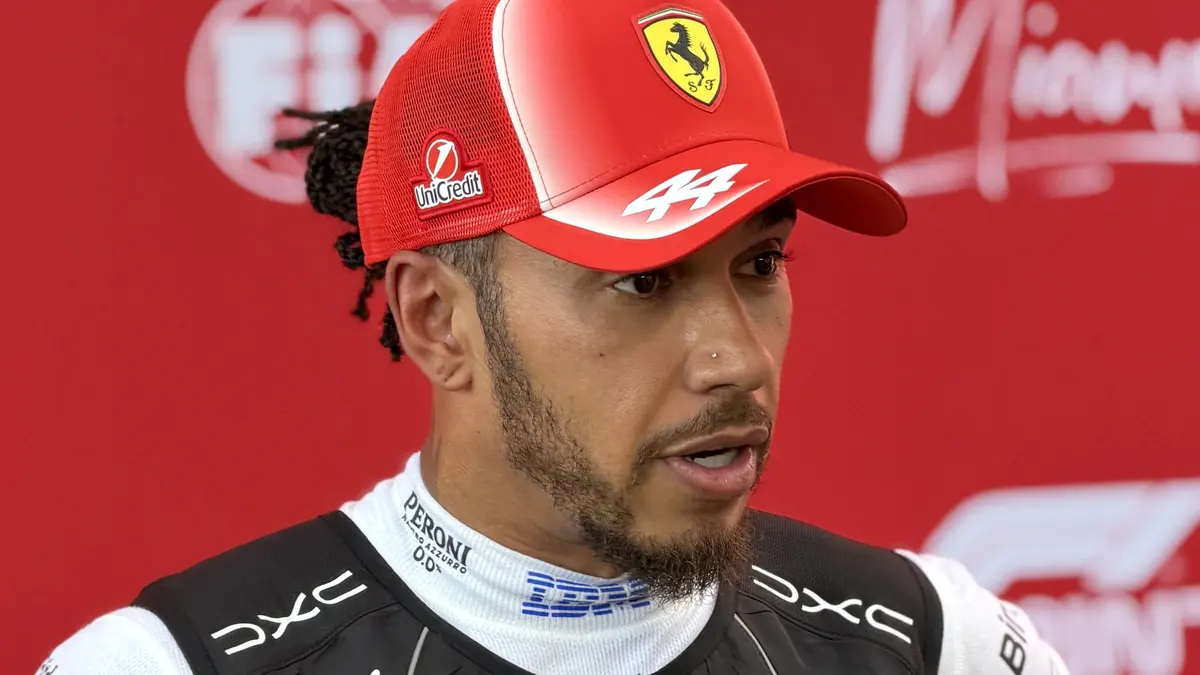
According to Jogo Hoje, the headline from Miami is already bigger than a single driver rant: Lewis Hamilton is pushing Ferrari to investigate why the other cars are extracting more performance from the front wing. And when the aerodynamics are the battleground, you don’t shrug it off, you go to the drawing board.
Ferrari rolled out a package of updates in Miami, yet Hamilton still finished 6th, almost 1 minute behind the winner Andrea Kimi Antonelli. That gap doesn’t just sting the scoreboard, it raises a brutal question about the current car concept and the downforce they’re able to generate when the track tightens and the performance in corners decides everything.
What Hamilton said after the Miami GP
Hamilton’s message to the team was direct, but the intent was technical: Ferrari needs to compare their approach with what rivals are doing. He acknowledged that the team worked hard to make the Miami improvements count, but stressed that everyone else moved too.
In his words, he’s heard that McLaren found a bigger gain than expected. That’s the tell. If the rivals are getting a larger return on the same development time, then the issue isn’t effort, it’s direction. He then framed it as a front-wing philosophy gap rather than a simple setup miss.
Why the front wing became the center of the complaint
The front wing isn’t just a piece of carbon bolted to the nose. In modern aerodynamics, it’s a lever that shapes airflow, stabilizes the car under load, and helps the team generate the right downforce across different phases of a lap.
Hamilton is basically saying: “If our corner confidence and traction aren’t matching the front-runners, look at the front wing first.” That’s not nostalgia. That’s systems thinking. The front wing influences how the car behaves when you turn in, how it holds the line mid-corner, and how quickly it can balance load before the exit. When the hierarchy starts to form early, the grid hierarchy can shift fast—especially with the season still young.
And yes, the timing matters. The next major opportunity is the GP of Canada, scheduled for May 22 to 24, the fifth round of the 2026 campaign. A small step here can become a big leap by the time the summer stretch arrives.
What Ferrari, Mercedes, Red Bull and McLaren show in their car concepts
Hamilton’s core claim is that Mercedes, Red Bull and McLaren are running a different solution on the front wing, and that Ferrari hasn’t matched that evolution. He’s not just talking about parts. He’s pointing at philosophy: different geometry, different flow management, different trade-offs between grip, drag, and stability.
Here’s the way we read it tactically:
- Mercedes and Red Bull are being treated by Hamilton as having progressed the front-wing package in a way that better converts into cornering stability and predictable bite.
- McLaren is the “higher-than-expected gain” case, suggesting their car concept is extracting more performance from the same development window.
- Ferrari, despite a robust upgrade package in Miami, appears to be lagging in how their front-wing design feeds the overall downforce balance—meaning the car may be working harder than it should to do the same job.
Hamilton’s line about simply comparing the wings is telling. Sometimes the answer is hiding in plain sight: you don’t need a spreadsheet to see that the shapes and details aren’t equivalent. It might not be only the wing, but it’s the most obvious lever. And if it’s the most obvious lever, why isn’t Ferrari getting the same payoff?
The impact of upgrades before the GP of Canada
Ferrari brought a serious package of updates to Miami, but the result—Hamilton in 6th, and nearly a minute back—signals that the upgrade package didn’t close the gap. That doesn’t mean the work was wasted. It means the correlation between what Ferrari expected and what the track delivered isn’t tight enough.
Now Mercedes is preparing their first update package for the end of May, and that sets up a classic early-season trap: you can’t fall behind in the aerodynamics arms race and hope the problem disappears. The front wing discussion becomes urgent because it’s tied to how quickly Ferrari can rebuild confidence and performance in performance in corners.
Canada is where you find out whether a concept is truly strong. If the front-wing philosophy is wrong, the car will feel inconsistent as grip comes and goes. If it’s right, the car starts to look “free” through medium-speed sections and more stable when the tires are loaded. That’s why Hamilton’s timing—press now, analyze fast—makes so much sense.
O Veredito Jogo Hoje
Hamilton isn’t chasing headlines—he’s demanding a technical autopsy. When the front wing is the first place you look, it usually means the team’s downforce and aerodynamics philosophy aren’t converting into the corner-by-corner confidence rivals are stacking. Ferrari can’t afford to treat this as “another Miami.” If Mercedes, Red Bull and McLaren are getting more out of their car concept, then Ferrari’s job in the run-up to the GP of Canada is simple: prove they understand why the grid hierarchy is moving and whether their next step can actually change the pecking order—because excuses don’t brake later.
— Analista Tático, Jogo Hoje
Perguntas Frequentes
What did Hamilton criticize in Ferrari after the Miami GP?
He pushed for a deeper Ferrari review, arguing that Mercedes, Red Bull and McLaren are extracting more performance from the front wing. Despite Ferrari’s package of updates, the gap in results—Hamilton in 6th and nearly a minute behind the winner—made him question Ferrari’s current approach and correlation of its aerodynamics.
Why is the front wing so important for F1 performance?
Because the front wing strongly influences airflow management and how the car generates downforce. That affects stability and grip when braking, turning in, and loading the tires—so it directly shapes performance in corners and often determines who gets the better fight for early-season grid hierarchy.
When is the next F1 race after Miami?
The next event is the GP of Canada, scheduled for May 22 to 24, the fifth round of the 2026 season.