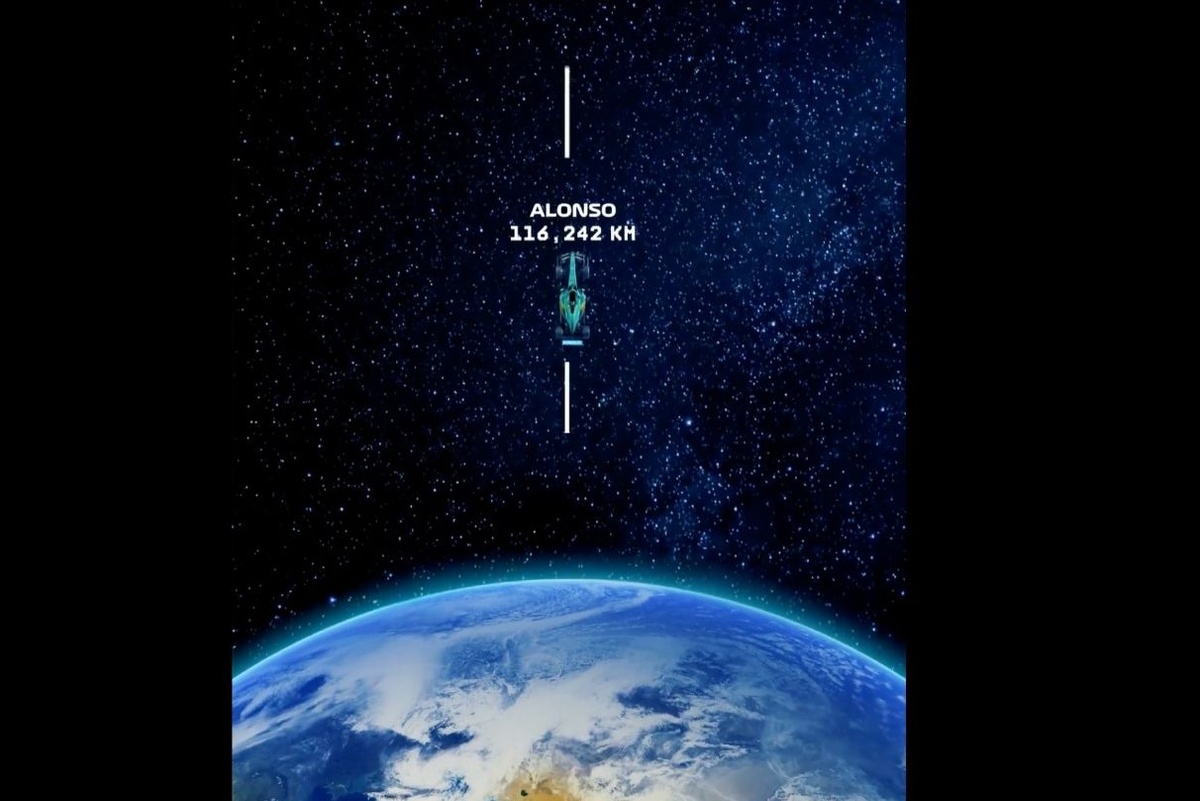
According to Jogo Hoje, this is the kind of stat that makes you stop watching the lap times and start watching the numbers. F1 took every driver’s career mileage across eras and turned it into a space-age talking point, using a recent NASA distance benchmark to make the scale feel almost unreal. Nerdy? Absolutely. Addictive? Even more.
The number F1 turned into a space curiosity
On April 6, NASA confirmed that the Orion spacecraft logged roughly 406,778 km during the Artemis II mission, setting a new human-distance mark. The previous record dated back to 1970, held by Apollo 13. Then F1 did what F1 does best: it packaged the obsession into something visual, comparing the grid’s career mileage against the distance Terra-Luna benchmark — the 384,400 km gap between Earth and the Moon.
And yes, the hook is pure entertainment. But tell me you didn’t grin when the overlay hit the screen.
Why Alonso tops this comparison
Here’s the cleanest takeaway from the ranking historical that F1 built from debut-to-present totals: no current grid driver, and no one from the category’s history shown in the comparison, matches the full Earth-to-Moon scale. Yet Fernando Alonso is the one who gets closest — hovering at about 384,400 km away from the “Moon line.” That’s not just longevity bragging rights. That’s precision plus grit stretched over seasons.
He’s not the oldest guy on the grid, sure. But this is the kind of longevity in Formula 1 metric that quietly tells the truth: keep showing up, keep finishing the work, keep adapting. Over time, that’s what turns a career into a spreadsheet that practically writes its own legend.
What the distance reveals about longevity in Formula 1
In racing, we obsess over peaks. Wins, poles, podiums. But this stat flips the lens. It rewards the drivers who stacked years like they were points on a table that never resets. When you compare career mileage to a fixed cosmic distance, you’re really measuring something else: how long a driver maintained the ability to be present at the sport’s sharp end.
That’s why this becomes more than a curiosity. It’s a reminder that the best two-time world champion careers aren’t just built on fireworks. They’re built on consistency, adaptability, and staying relevant when the rules, cars, and teams all rotate underneath you.
NASA’s records and the Artemis II hook
The Artemis II tie-in matters because it gives the comparison a real-world anchor. NASA’s Orion milestone — those ~406,778 km on April 6 — is the kind of distance that makes your brain struggle to visualize it. F1 borrowed that confusion and turned it into a scoreboard you can actually feel.
So when the overlay suggests Alonso is the closest match to the distance Terra-Luna reference, you’re not just looking at trivia. You’re watching F1 translate human exploration energy into a sport-specific ranking historical story — the recorde da Artemis II as a backdrop for a career narrative.
Who else appears in the ranking and what it says about the grid
Even without naming every driver in the graphic, the structure of the comparison tells a story about the modern era: fewer drivers accumulate massive mileage because careers can be shorter at the top, and the sport’s evolution demands faster cycles of adaptation. The grid is deeper, the competition is tighter, and the margin for survival is thinner.
That’s why Alonso’s proximity stands out. When you’re measuring longevidade na Fórmula 1 in kilometers, the drivers who dominate aren’t always the ones with the most hype. They’re the ones who keep their seat long enough to rack up the numbers — and keep doing it while the sport changes its skin every few years.
And yes, it’s a reminder that teams and drivers are linked to the calendar as much as to the gearbox. If you’re into the Alonso ecosystem, you can also trace it through Aston Martin and the broader Fernando Alonso storylines that keep resurfacing when longevity gets the mic.
O Veredito Jogo Hoje
Call it a gimmick if you want, but this is the rare stat that actually lands. Alonso isn’t “winning” space trivia; he’s winning the long game — the kind of longevity na Fórmula 1 that only shows up when you let time do the talking. F1 turned career mileage into a distance Terra-Luna spectacle, and Alonso became the closest dot to the Moon. That’s not luck. That’s the ranking histórico doing what it’s supposed to do: expose who can endure.
— Nerd Estatístico, Jogo Hoje
Perguntas Frequentes
How many kilometers did Alonso cover in his F1 career?
F1’s comparison places Fernando Alonso as the driver who comes closest to the distance Terra-Luna reference using his total career mileage across seasons.
Which F1 driver comes closest to the Earth–Moon distance?
Fernando Alonso is the one who most approaches the distance Terra-Luna benchmark in the F1 ranking historical comparison.
What NASA record was used in the comparison?
NASA’s benchmark was the recorde da Artemis II distance: the nave Orion reaching about 406,778 km on April 6, surpassing the Apollo 13 record from 1970.