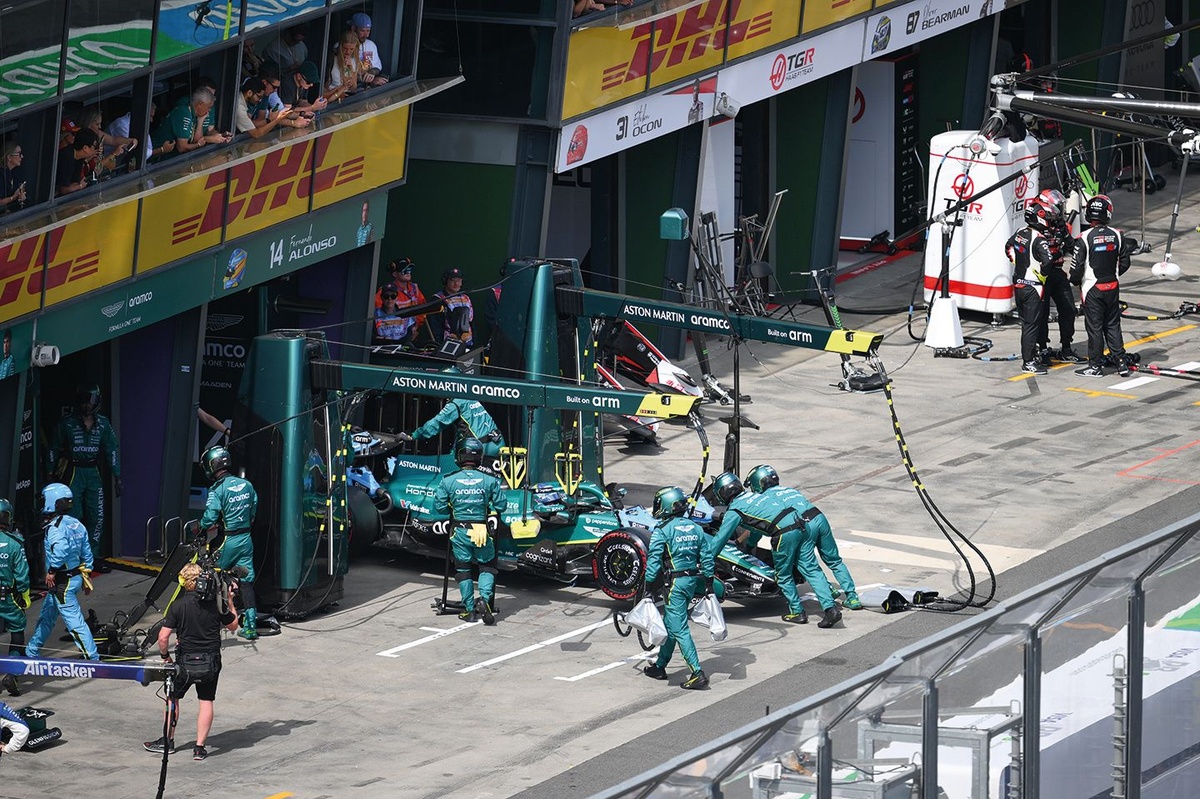
According to Jogo Hoje’s F1 coverage, the Aston Martin situation in 2026 is the kind of problem that doesn’t just show up on a lap chart, it shows up in the way the car behaves: unstable, nervous, and hard to trust at the limit. And now, David Croft has added a new timeline to the noise, suggesting the team could bring a different specification of the AMR26 to the European calendar.
What Croft revealed about the AMR26 B spec
Croft, speaking on The F1 Show, said Aston Martin may have a “B” model option available for the AMR26, with the most likely first appearance at the Belgian Grand Prix. The key detail isn’t just the date, it’s the intent: this isn’t framed as a quick fix, but as a gradual evolution aimed at solving issues that, in Croft’s view, were not caught early enough.
The backdrop matters. Aston Martin started 2026 in performance trouble, and the team is pushing an upgrade approach that touches multiple layers at once: chassis behavior, integration carro-motor (car-engine integration), and the way the power unit communicates its demands back into the rest of the platform. Croft even points to the broader project management angle, arguing that “all aspects” of the development work may have been handled with a bit less precision than the situation required.
Why Spa-Francorchamps became the most likely date
Timing in F1 isn’t vibes, it’s physics and workload. Croft floated two potential windows for a meaningful update: Silverstone and Spa-Francorchamps. If you’re looking for a “B-spec” style package, Silverstone is described as the place it could appear, but the sharper call is that Spa is the more likely target.
Why does Spa make sense tactically? Because it’s a circuit that punishes weakness in the full-system chain. When the chassi can’t properly support the power unit, you don’t just lose speed. You get the kind of instability that turns setup into a guessing game. Croft’s comments land on one theme repeatedly: the team must stop the car from suffering excessive vibration, and that kind of problem tends to reveal itself consistently across long, high-load phases and braking zones.
And there’s a storyline beat in his framing: finishing the race in Japan was a “wow” moment for the team, but it’s also treated like evidence of progress in a longer arc, not proof that the core issues are already solved. Then comes the calendar reality: improvements are expected to come back after the Natal interval, implying a deeper optimization cycle rather than a one-off sprint.
In other words, Spa isn’t just a random date on the calendar. It’s the first European stage where Aston can justify a meaningful package de meio de temporada and gather clean feedback before the post-break refinement.
Which problems Aston Martin is trying to correct
If you strip away the commentary and look at the mechanics, the shopping list is pretty clear. Croft essentially ties Aston’s struggles to a mismatch between the chassi and the power unit, with vibração acting like the symptom that makes everything else harder.
- Chassis support: the frame must be able to “carry” the power unit’s characteristics without letting the whole platform oscillate out of its happy range.
- Power unit tuning: Croft says the component will need “a lot of work and adjustments,” which is code for calibration, mounting behavior, and integration decisions being revisited rather than merely refreshed.
- Car-engine integration: the whole point is integration carro-motor. If the interface isn’t stable, every aero change, every wing choice, every suspension tweak becomes harder to interpret.
- Atualização aerodinâmica alignment: even when the team brings an update, aero can’t compensate for a platform that’s fighting itself. The atualização aerodinâmica needs to land on a car that can actually deliver repeatable load and airflow.
There’s also a brutal practical implication: Croft expects Aston Martin to “have problems throughout the season” until the chassi is ready to handle the new direction. That’s the kind of statement that tells you the upgrade is as much about engineering maturity as it is about raw performance.
What it means to call the engine a “beta” for 2027
The most intriguing technical line in Croft’s comments is the one about the engine. He says the unit for the current upgrade path will be the “version ‘beta’” of the 2027 project, and that it will likely return after the Natal interval in better condition.
Translated for fans: Aston might be running a stepping-stone power unit concept now, not only to chase 2026 points, but to de-risk the bigger plan for development of 2027. That’s not unusual in top teams, but it becomes risky when the current year’s car-engine integration is already fragile.
Think of it like running a prototype software build while the hardware platform is still being stabilized. If the vibration problem remains, the team loses time learning what they actually need to learn for 2027, because 2026 becomes a moving target.
Why the chance of points in 2026 stays low
On the points question, Croft is blunt, and honesty in F1 is rare. He suggests Aston may add “some” points only if the chaos works in their favor, specifically mentioning a scenario where many cars fail to finish. That’s a reality check: finishing in Japan was progress, but not a platform breakthrough.
We’ve all seen teams get a little too romantic about reliability milestones. Croft is basically saying: don’t celebrate a controlled finish when the underlying chassi and power unit relationship still isn’t stable enough to drive consistent performance. If vibração is still there, it impacts tire life, braking confidence, and the ability to exploit traction zones without fighting the car.
So when Aston Martin targets Spa as the first major “B-spec” moment, the real question is: does it fix enough of the chain to turn “survival” into “strategy”? Or does it simply raise the ceiling while keeping the floor shaky?
O Veredito Jogo Hoje
Jogo Hoje’s call: Spa is the right hunting ground, but it’s also a trap door. Croft’s timeline reads like a team chasing system-level stability, not miracles, and that means the AMR26 B spec only becomes a “turning point” if it truly calms the vibration and locks the integration carro-motor into something repeatable. If the chassi still can’t control the power unit, the update becomes just another expensive patch in a season where points are mostly lottery tickets. That’s why we’re worried: 2026 needs a cure, and this looks more like a rollout plan for 2027.
— Editorial Desk, Jogo Hoje
Perguntas Frequentes
O que é um carro “B” na Fórmula 1?
É uma especificação alternativa do mesmo modelo do carro, normalmente com mudanças em pacotes de engenharia como atualização aerodinâmica, configurações mecânicas e, às vezes, partes do conjunto chassi e de integração carro-motor. A ideia é corrigir problemas ou elevar o desempenho com uma nova leitura do pacote técnico.
Por que Spa-Francorchamps é o palco mais provável para a estreia?
Porque Spa tende a expor fraquezas de estabilidade e carregamento em alta e média rotação, deixando claro se a vibração e a relação chassi-power unit foram realmente endereçadas. Croft também sugere que Silverstone pode receber algo parecido, mas que Spa é o alvo mais provável para uma atualização mais decisiva.
Aston Martin ainda pode pontuar em 2026?
Pode, mas a projeção de Croft é cautelosa: ele indica que os pontos dependeriam muito de circunstâncias externas, como abandonos de outros carros. A mensagem é que o time ainda deve passar por dificuldades durante a temporada até o chassi suportar melhor a unidade de potência e reduzir a vibração.